Academic Areas
A K–12 Journey, Rooted in Biblical Truth and Built for Tomorrow
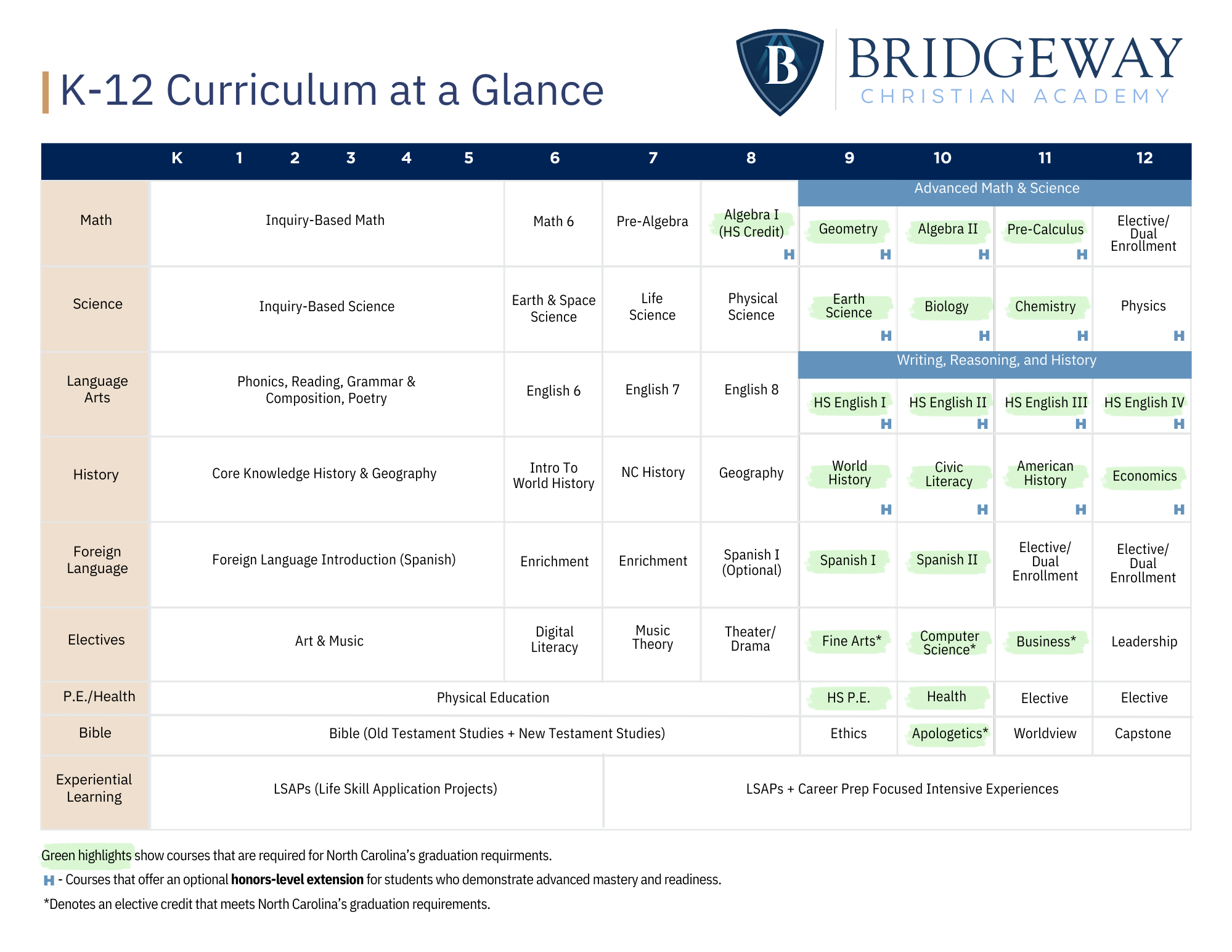
Instructional Focus at a Glance
Across K–12, students engage in:
- Math
- Science
- Language Arts
- History & Social Studies
- Foreign Language
- Fine Arts & Electives
- P.E. & Health
- Bible & Worldview
- Experiential Learning & Life Skills
The chart highlights:
- Green courses that satisfy North Carolina graduation requirements
- Courses marked with “H” that offer an optional honors-level extension for students who demonstrate advanced mastery and readiness
- Electives marked with an asterisk (*) count toward
NC elective graduation requirements
Lower School
Kindergarten - 5th Grade
Middle School
6th - 8th Grades
Upper School
9th - 12th Grades
Lower School (K–5): Early Foundations
In the elementary years, the focus is on strong literacy, numeracy, curiosity, and biblical foundations.
Math & Science
- Inquiry-Based Math (K–5) builds deep number sense, problem solving, and conceptual understanding—students don’t just memorize; they understand and apply.
- Inquiry-Based Science
in the early grades introduces students to observing, questioning, and exploring God’s creation.
Language Arts
- Phonics, Reading, Grammar & Composition, Poetry
give students a strong reading and writing foundation, equipping them to think, communicate, and enjoy great literature from an early age.
History & Geography
- Core Knowledge History & Geography
provides a rich, chronological exposure to cultures, events, and big ideas that help students see God’s story unfolding across time and place.
Foreign Language & Electives
- Foreign Language Introduction (Spanish) introduces basic vocabulary and conversation.
- Art & Music
allow students to explore creativity and expression while building confidence and discipline.
Bible & Experiential Learning
- Bible instruction centers on Old and New Testament stories and themes, helping children understand who God is and who they are in Him.
- Life Skill Application Projects (LSAPs) begin to appear as age-appropriate opportunities for hands-on, real-world learning.
Middle School (6-8): Deepening Knowledge & Skills
In grades 6–8, students transition into more
advanced concepts
while still being supported through intentional structures.
Math & Science
- Math 6, Pre-Algebra, and Algebra I (High School Credit) introduce more advanced concepts and prepare students for upper-level math.
- Earth & Space Science,
Life Science, and
Physical Science
deepen scientific understanding and lab-based learning.
Language Arts & History
- English 6, English 7, and English 8 develop reading comprehension, literary analysis, and increasingly sophisticated writing.
- Students study
NC History,
Intro to World History, and
Geography, gaining context for civic engagement and global awareness.
Foreign Language & Electives
- Spanish I (Optional in 8th grade) allows students to get an early start on fulfilling high school language requirements.
- Elective offerings such as
Digital Literacy,
Music Theory, and
Theater/Drama
give students a variety of ways to explore interests and build confidence.
Bible & LSAPs
- Bible continues as a core subject, with students building biblical literacy and beginning to grapple with deeper questions of faith and practice.
- LSAPs (Life Skill Application Projects) become more robust, giving students structured opportunities to apply content knowledge in real-world scenarios.
Upper School (9-12): Advanced Coursework & Calling
High school at Bridgeway builds toward
graduation, readiness, and calling—academically strong, spiritually grounded, and practically prepared.
Advanced Math & Science
Students can pursue a full college-prep math and science progression:
- Algebra I (option to earn credit in 8th), Geometry, Algebra II, Pre-Calculus
- Earth Science,
Biology,
Chemistry,
Physics
Writing, Reasoning, and History
The high school humanities sequence emphasizes critical thinking, communication, and civic understanding:
- HS English I–IV: literature, composition, research, and rhetoric
- World History,
Civic Literacy,
American History, and
Economics
Students learn to read closely, write clearly, and engage with history and culture from a biblical worldview.
Foreign Language
- Spanish I and Spanish II are offered in high school, meeting foreign language recommendations for many colleges and opening doors for cross-cultural engagement.
- American Sign Language (ASL) and other foreign languages may be offered based on interest and enrollment.
Electives, Dual Enrollment & Career Exploration
Bridgeway offers electives and intensives that help students explore interests and build career-relevant skills:
- Fine Arts* (visual art, music, performance)
- Computer Science*
- Business*
- Leadership
- Praise and Worship Band
- Culinary Arts
- Woodshop
In grades 11–12, students will be able to access
Dual Enrollment
options, allowing them to earn college credit or pursue specialized areas of interest in partnership with outside institutions.
P.E., Health & Wellness
- High School P.E.,
Health, and additional wellness-focused electives help students develop healthy lifelong habits and respect for how God designed their bodies.
Bible, Ethics, and Worldview
Biblical formation is
not
an add-on—it’s a core part of the curriculum.
Across high school, students move through:
- Bible (Old Testament + New Testament Studies)
- 9th - Ethics
- 10th - Apologetics* (meets an elective requirement)
- 11th - Worldview
- 12th - Capstone
(a culminating project that integrates biblical worldview, calling, and post-graduation plans)
Our goal is for students to graduate with a faith that is thoughtful, resilient, and lived out in everyday decisions.
LIFE SKILLS APPLICATION PROJECTS
How We Incorporate Life Skills
Experiential Learning & Life Skills
Throughout K–12,
LSAPs (Life Skill Application Projects) give students hands-on ways to apply what they’re learning—academically, practically, and spiritually.
In high school, LSAPs are paired with Career Prep Focused Intensive Experiences, helping students:
- Explore career paths and interests
- Develop real-world skills (communication, project management, financial literacy, entrepreneurship, leadership)
- Make informed decisions about college, work, and calling
This combination ensures students don’t just graduate with credits—they graduate with experience.